Practitioner-developed methods

Methods & Approaches

Three related frameworks for thinking about therapeutic work: first understand the structure, then update the response, then help successful change become sustainable.

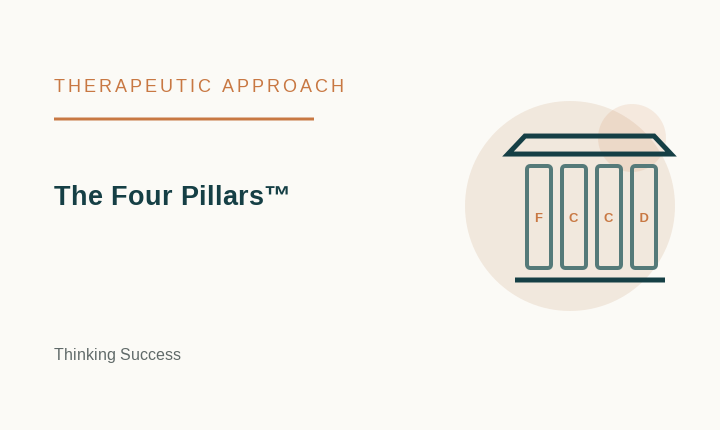
01FormulateThe Four Pillars™
02UpdateLearned Response Updating™
03ConsolidateDesired State Consolidation™

How they fit together

A connected way of thinking about formulation, change and maintenance.

These are not intended as three competing therapies. The Four Pillars™ provides the broad formulation architecture; Learned Response Updating™ focuses on the learned prediction and protective-response loops that can maintain a pattern; Desired State Consolidation™ focuses on helping a successful new state become familiar, usable and sustainable.

Formulate

The Four Pillars™

The Four Pillars is a practitioner-developed formulation framework for understanding how a person’s difficulties may organise around four broad domains: Freedom, Connection, Control and Doubt / Self-Trust. It is designed to help therapists move from a list of symptoms to a clearer picture of what is being threatened, protected or compensated for.

Primary objective

Identify which of the four domains is under strain, over-used or being protected.

Explore The Four Pillars™ →
Update

Learned Response Updating™

Learned Response Updating focuses on a simple clinical proposition: people often respond not only to what is happening now, but to what previous learning predicts will happen next. Protective responses can therefore continue long after the original conditions have changed. The method helps the therapist identify that prediction, understand the response it generates, and create credible new experience from which more flexible responding can be learned.

Primary objective

Identify the expected outcome that is driving the current response.

Explore Learned Response Updating™ →

Consolidate

Desired State Consolidation™

Desired State Consolidation addresses a problem that can appear after therapeutic change has apparently succeeded: the person can reach the desired state, yet still find it unfamiliar, difficult to inhabit or surprisingly hard to sustain. The method separates attainment from habitation and consolidation, then works with the predictions and protective responses that can arise when a new way of being does not yet feel like the familiar self.

Primary objective

Distinguish successful attainment from the ability to inhabit and sustain the change.

Explore Desired State Consolidation™ →

A practitioner framework, not a new diagnosis

Designed to support clinical thinking.

Each method is intended to help a therapist organise information, clarify a change target and select interventions more deliberately. They can sit alongside established therapeutic approaches; they are not intended to replace assessment, professional judgement, supervision or evidence-based care.

Training

Practitioner training and supporting materials for these methods are being developed through Thinking Success.

Explore therapist training →